
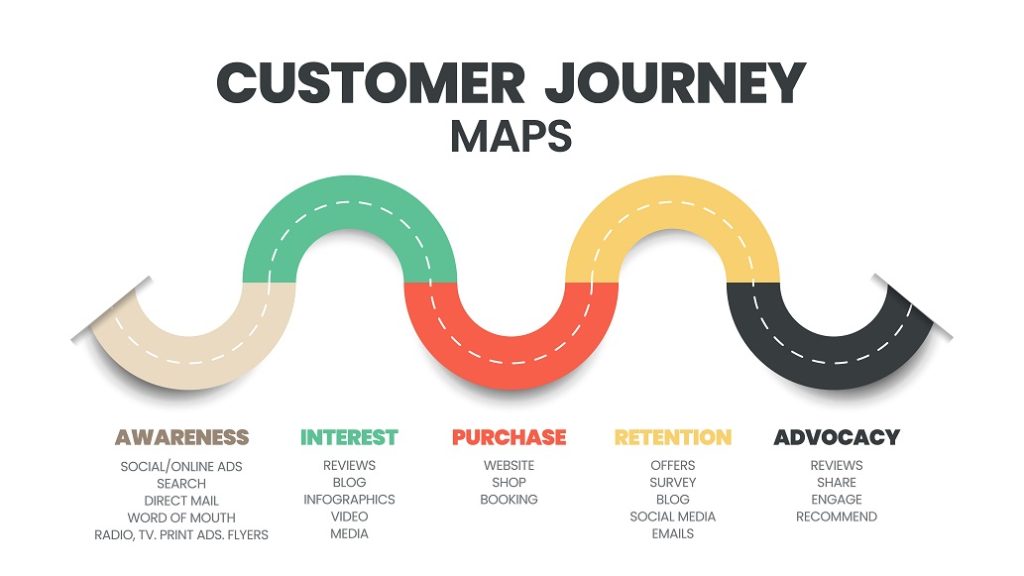
In our last post, “How to Build a Full-Funnel Marketing Strategy That Actually Works,” we discussed how businesses need to show up at every stage of the buying process — from awareness to decision and beyond. A full-funnel strategy gives your marketing direction. It ensures you’re not relying on a single channel or a one-touch interaction to drive growth.
But strategy alone doesn’t produce results.
The real impact happens when you understand how customers actually move through that funnel. Because while a full-funnel framework outlines what should happen, customer journey mapping reveals what is happening.
For local businesses, this journey is tangible. It often starts with a Google search, moves through reviews and website visits, and ends with a phone call, form submission, or in-person visit. If friction exists at any point, potential customers don’t hesitate — they choose a competitor.
Customer journey mapping is what turns visibility into measurable growth.
What Is Customer Journey Mapping?
Customer journey mapping is the process of outlining every interaction a customer has with your business, from first discovery to repeat purchase.
For a local business, that journey may include:
- Finding your business in Google search results
- Viewing your Google Business Profile
- Reading online reviews
- Visiting your website
- Calling directly from a mobile device
- Submitting a contact form
- Visiting your physical location
- Receiving follow-up communication
- Leaving a review or returning for future service
When you step back and view these interactions as one connected experience rather than isolated marketing efforts, patterns begin to emerge. You can see where customers engage confidently and where they hesitate.
That clarity changes how you make marketing decisions.
Why It Matters for Local Businesses
Many local businesses invest in SEO, paid ads, and website improvements, yet still struggle to understand why revenue feels inconsistent.
You may notice:
- Traffic increasing without a rise in conversions
- Ad clicks that don’t translate into calls
- Website visitors who leave quickly
- Strong rankings but unpredictable revenue
The problem often isn’t effort — it’s disconnect.
Customer journey mapping connects your marketing channels into one cohesive system. It highlights where potential customers drop off and where small improvements could significantly increase conversion rates.
Instead of guessing what’s working, you begin identifying exactly where performance breaks down.
Understanding the Modern Local Customer Journey
The journey typically begins with awareness. Someone searches for a service in their area. Your visibility in search — whether through local SEO, paid ads, or your Google Business Profile — determines whether you even enter the conversation.
Once aware of your business, the customer shifts into consideration. They compare you to competitors. They read reviews. They evaluate your website. They look for professionalism, credibility, and clear answers to their questions.
At the decision stage, convenience becomes critical. Customers are asking:
- Is the phone number easy to find?
- Does the website load quickly on mobile?
- Is pricing or service information clear?
- Is scheduling simple and immediate?
Small friction points here can undo all the work done in earlier stages.
After the purchase or service, the experience stage begins. Communication, follow-up, and overall satisfaction determine whether the relationship ends or continues.
Finally, loyalty and advocacy shape long-term growth. Repeat customers, referrals, and online reviews often generate the most profitable leads. Yet many businesses stop marketing once the sale is complete.
When you view these stages as interconnected rather than isolated, marketing becomes more intentional and effective.
How to Map Your Customer Journey
Creating a customer journey map starts with perspective.
Begin by identifying your primary customer type. A homeowner searching for emergency plumbing services behaves differently than someone planning a long-term renovation. Understanding intent shapes the path they take.
Next, outline every interaction that occurs from first search to final follow-up. Think about what the customer sees, clicks, reads, and experiences — both online and offline.
Then look for friction. Common issues include:
- Slow-loading mobile pages
- Confusing navigation
- Weak or outdated reviews
- Inconsistent messaging across platforms
- Complicated contact forms
Finally, align your marketing channels to support each stage intentionally. For example:
- SEO supports awareness.
- Website messaging strengthens consideration.
- Conversion optimization drives decisions.
- Email marketing and review strategies build loyalty.
Mapping the journey allows each channel to play a clear role rather than operating independently.
Where Local Businesses Often Miss Opportunities
One common mistake is treating SEO, paid advertising, and website optimization as separate initiatives. Without a mapped journey, these efforts don’t reinforce one another.
Another issue is focusing exclusively on traffic instead of conversion behavior. More visitors don’t automatically mean more customers. What matters is how smoothly those visitors move toward action.
Many businesses also overlook post-sale engagement. Without structured follow-up, review generation, or retention strategies, growth becomes dependent on constantly acquiring new customers instead of maximizing lifetime value.
When the journey isn’t clearly mapped, marketing becomes reactive rather than strategic.
Turning Strategy Into Measurable Results
A full-funnel strategy provides the blueprint. Customer journey mapping provides the execution plan.
When you understand how customers truly interact with your business, you can:
- Eliminate friction that prevents conversions
- Improve ad efficiency and ROI
- Strengthen organic visibility
- Increase customer lifetime value
- Create more predictable revenue growth
Instead of operating as a collection of marketing tactics, your efforts function as a connected system designed to guide customers from discovery to loyalty.
That’s when full-funnel marketing begins to deliver real, measurable results.